

Banishing the Green with Expert Algae Removal Pool Service
When Your Pool Turns Green: What You Need to Know About Algae Removal Pool Service
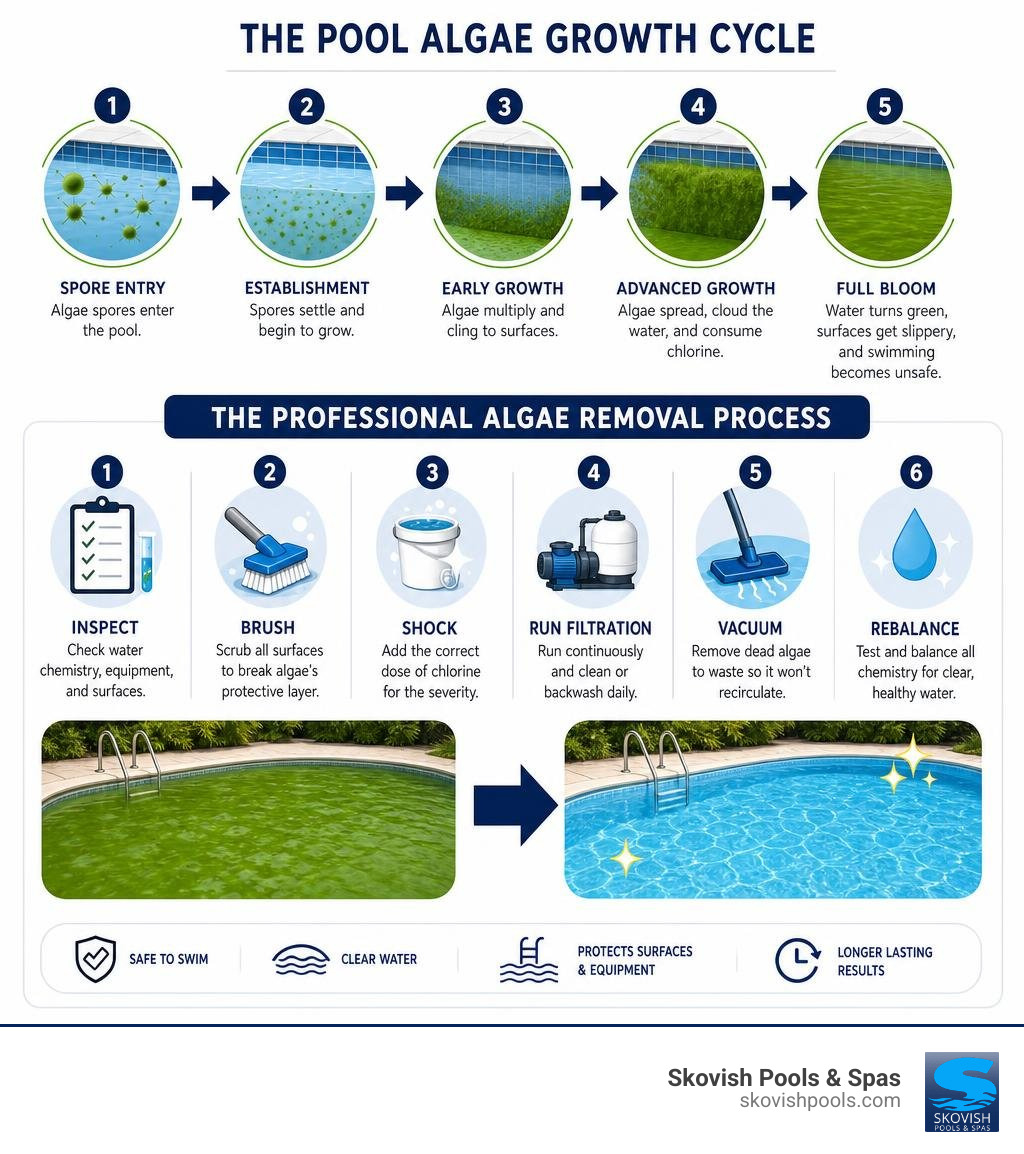
Algae removal pool service is the process of professionally diagnosing, treating, and eliminating algae from your swimming pool — and fixing the root cause so it doesn’t come right back.
Here’s a quick overview of what that looks like:
- Inspect the water chemistry, equipment, and surfaces
- Brush all walls, steps, and corners aggressively to break algae’s protective layer
- Shock the pool with the correct dose of chlorine based on severity
- Run filtration continuously and backwash or clean the filter daily
- Vacuum dead algae directly to waste to prevent it from recirculating
- Rebalance all water chemistry after the water clears
One day your pool looks fine. A few days later, it’s green.
That’s not just bad luck. It usually means something went wrong with your water chemistry, your filtration, or both. And once algae takes hold, simply dumping in a bag of shock rarely solves it — especially if you don’t know why it started in the first place.
Algae also isn’t just an eyesore. It makes pool surfaces dangerously slippery, depletes your chlorine rapidly, clogs filters, and can make the water unsafe to swim in.
The good news? With the right process, even a dark green swamp of a pool can be restored to crystal-clear water — usually within a week.
I’m Marty Skovish, Senior Manager at Skovish Pools & Spas, and after more than four decades working with pools across Northeastern Pennsylvania, I’ve seen every kind of algae bloom imaginable — and helped thousands of pool owners get ahead of it with professional algae removal pool service. In this guide, I’ll walk you through exactly how the process works, why DIY often falls short, and how to keep your pool clean for good.
Understanding the Enemy: Types of Pool Algae and Their Behaviors
To successfully clear a pool, you have to know exactly what kind of organism you are fighting. Algae is a single-celled plant form that thrives on sunlight, water, and organic nutrients (like phosphates and nitrates). However, not all algae are created equal. Some float freely in the water, while others anchor themselves deep into the micro-pores of your pool plaster or tile grout.
| Algae Type | Color & Appearance | Key Characteristics | Treatment Difficulty |
|---|---|---|---|
| Green Algae | Light green to dark forest green; cloudy water | Most common; fast-spreading; floats and clings loosely | Easy to Moderate |
| Yellow (Mustard) Algae | Mustard-yellow or gold; resembles pollen or sand | Highly chlorine-resistant; clings to shady spots and equipment | High |
| Black Algae | Dark blue-green or black spots; raised nodules | Deep root systems; protective waxy coating; grows in plaster | Very High |
| Pink Slime | Pinkish-red or orange slimy streaks | Actually a bacterial biofilm; loves plumbing lines and skimmers | Moderate |
| White Water Mold | White, tissue-like shreds floating in water | Fungal-like bacterial growth; clogs filters rapidly | Moderate |
Identifying different algae types is the critical first step. If you misdiagnose yellow or black algae as simple green algae, your standard treatment will fail, wasting both your time and your money.
Green Algae: The Most Common Invader
Green algae is the classic culprit behind the dreaded “swamp pool.” It is opportunistic and incredibly fast-growing. If your free chlorine level drops below 1 ppm for even a few days, a microscopic spore can turn into a massive, visible bloom almost overnight—especially under the hot July 2026 sun.
Green algae floats freely in the water, giving it a turbid, pea-soup appearance, and coats the pool floor and walls in a slippery, slimy film. Because it is highly sensitive to sanitizers, learning how to eliminate swimming pool algae of this variety usually involves standard shock chlorination, provided your water chemistry parameters are aligned.
Yellow and Black Algae: Stubborn Strains Requiring Algae Removal Pool Service
If you notice yellow, powdery patches on the shady side of your pool steps, or small, stubborn black spots on your plaster that refuse to brush away, you are dealing with much tougher adversaries.
Yellow (or mustard) algae is highly resistant to normal chlorine levels. It does not turn the whole pool green; instead, it behaves like a stubborn dust that settles on pool walls and floor corners. It is notorious for hitchhiking on pool toys, floats, and cleaning equipment, meaning a pool can easily be re-seeded if everything that touches the water isn’t thoroughly sanitized.
Black algae is the absolute nightmare of pool owners. It is not a true algae, but a cyanobacteria that forms a physical, raised nodule with a waxy, protective outer head. Beneath this head, it sends microscopic roots deep into the plaster pores, tile grout, and concrete structures of your pool. Standard chlorine treatments cannot penetrate this waxy shell. Eradicating black algae requires specialized steel-bristle brushing to literally crack the shell open, followed by direct, targeted chemical applications.
For these stubborn strains, utilizing a professional algae removal pool service is often the only way to ensure the roots are fully destroyed and the spores are completely eradicated.
Why DIY Algae Treatment Often Fails
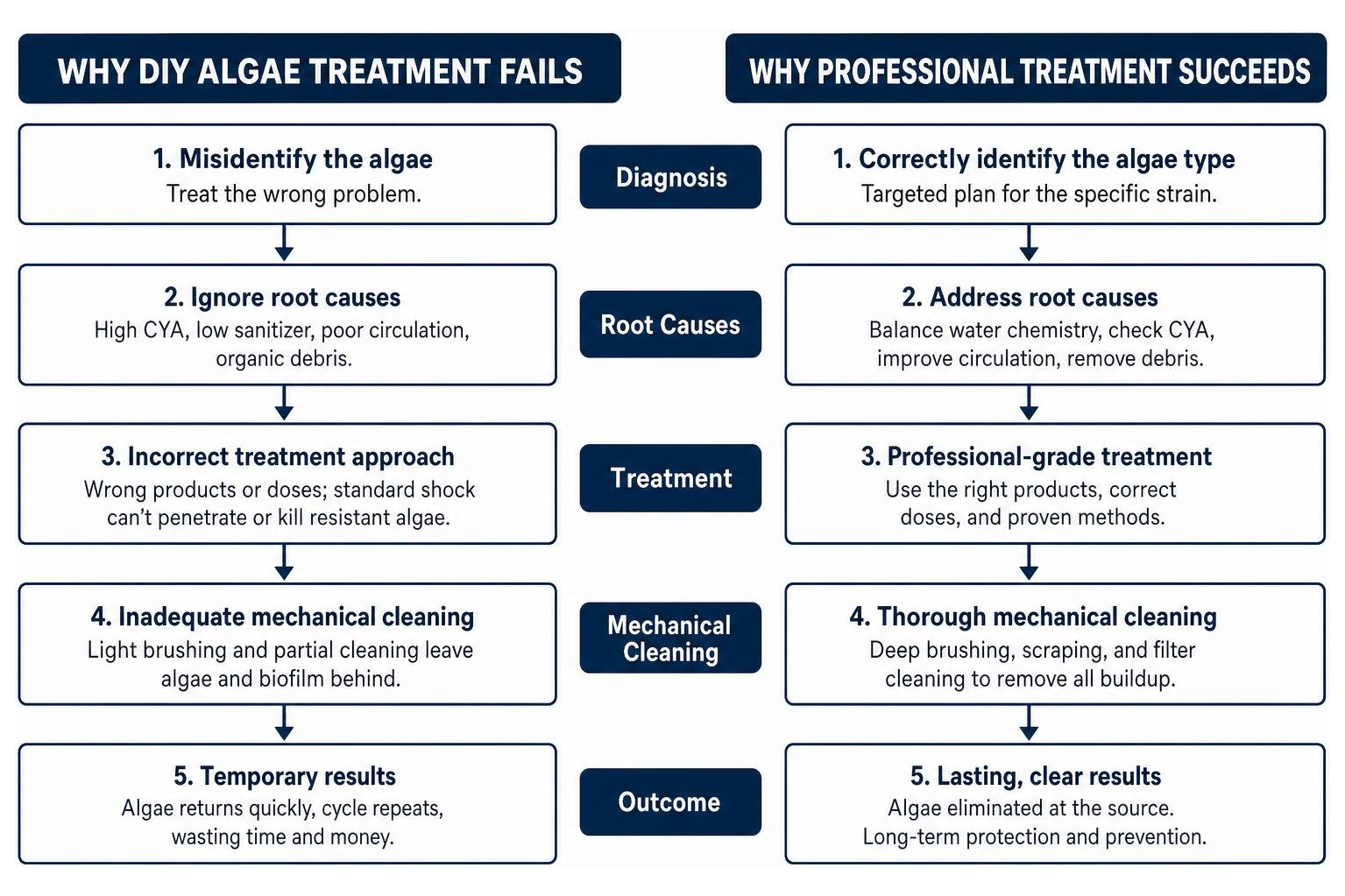
Many pool owners attempt to clear their green pools themselves, only to find themselves stuck in a frustrating loop: they dump in a few bags of shock, the pool clears slightly for a day, and then it turns right back to a swamp. This cycle occurs because DIY attempts rarely address the underlying chemical and mechanical failures that allowed the algae to bloom in the first place.
The Danger of Chlorine Lock and High CYA
The most common reason DIY treatments fail is “chlorine lock,” which is directly tied to Cyanuric Acid (CYA) levels. CYA is a stabilizer that acts like sunblock for your chlorine, protecting it from being instantly degraded by UV rays. However, there is a catch.
If your CYA level rises above 80 or 90 ppm, it binds too tightly to the chlorine molecules. This renders the chlorine completely ineffective at any normal dose. You could dump ten bags of shock into the pool, and the active, free chlorine will still be unable to sanitize the water or kill the algae.
The only way to resolve high CYA is to perform a partial drain and refill to dilute the stabilizer before starting your treatment. Without testing for CYA with professional-grade pool-spa chemicals and testing kits, homeowners are simply throwing money away on shock that cannot do its job.
Skipping Crucial Physical Steps
Chemicals alone do not clear a pool. Algae forms a protective biofilm layer over itself to shield its cells from sanitizers.
Many homeowners skip the exhausting, physical work of deep brushing and vacuuming. Without aggressive brushing, the chlorine cannot reach the active algae cells. Furthermore, when chlorine successfully kills algae, the dead organic matter sinks to the bottom of the pool. If this dead debris is not vacuumed directly to waste (bypassing the filter), it will recirculate, clog your filter media, and act as a rich nutrient source to fuel the next generation of algae.
To do this right, you need the proper physical gear and commercial-grade pool maintenance supplies. Skipping these laborious steps is why many homeowners eventually call for professional luzerne pool care cleaning maintenance repair to handle the heavy lifting.
The Step-by-Step Professional Algae Removal Pool Service Process
When our technicians arrive to perform a professional green-to-clean recovery, we follow a strict, multi-step scientific protocol. We don’t guess; we measure, treat, and verify.
Step 1 to 3: Inspection, Debris Removal, and Aggressive Brushing
- Detailed Inspection & Testing: We begin by testing the complete water chemistry profile (Free Chlorine, Combined Chlorine, pH, Total Alkalinity, Calcium Hardness, CYA, and Phosphates). We also check filter pressure, pump operation, and look for “dead zones” where poor water circulation might be harboring spores.
- Debris Removal: Before adding any chemicals, we skim the surface and scoop out all large organic debris, leaves, and twigs. Organic matter in the pool rapidly consumes chlorine, so removing it ensures that 100% of our shock treatment goes toward killing the algae.
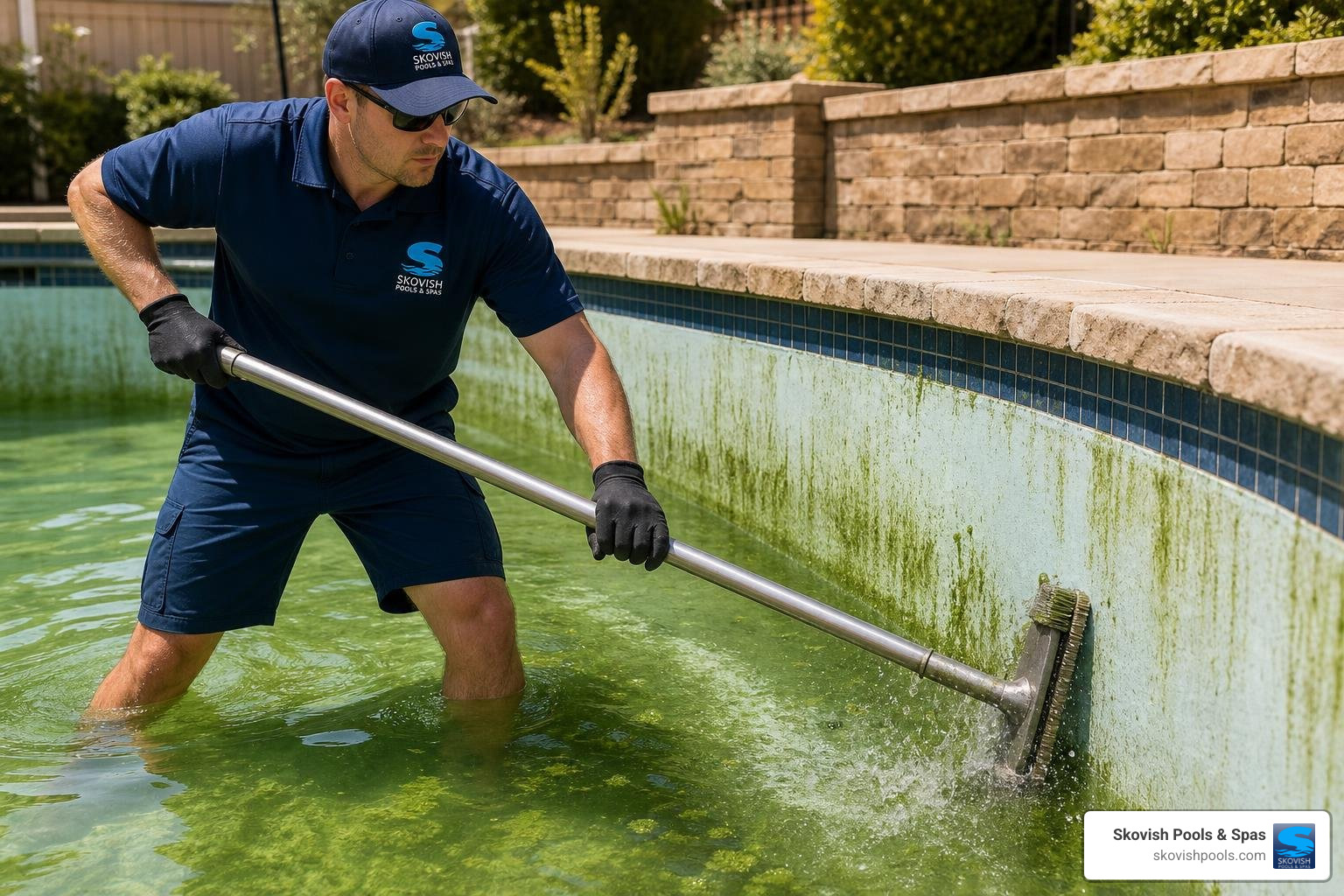
- Aggressive Brushing: We use specialized, heavy-duty brushes (including stainless steel wire brushes for plaster pools) to scrub every square inch of the pool. This breaks open the protective membranes of green, yellow, and black algae, exposing the vulnerable cells to the chemical treatment.
By securing a pure water pool cleaning service Wilkes-Barre PA, you ensure that these labor-intensive prep steps are executed flawlessly.
Step 4 to 6: Chemical Shocking, Filtration, and Vacuuming to Waste
- Breakpoint Chlorination: We calculate the exact chemical dose required to achieve “breakpoint chlorination”—the point at which we completely oxidize all organic contaminants and leave a strong, active free chlorine residual to wipe out the remaining spores.
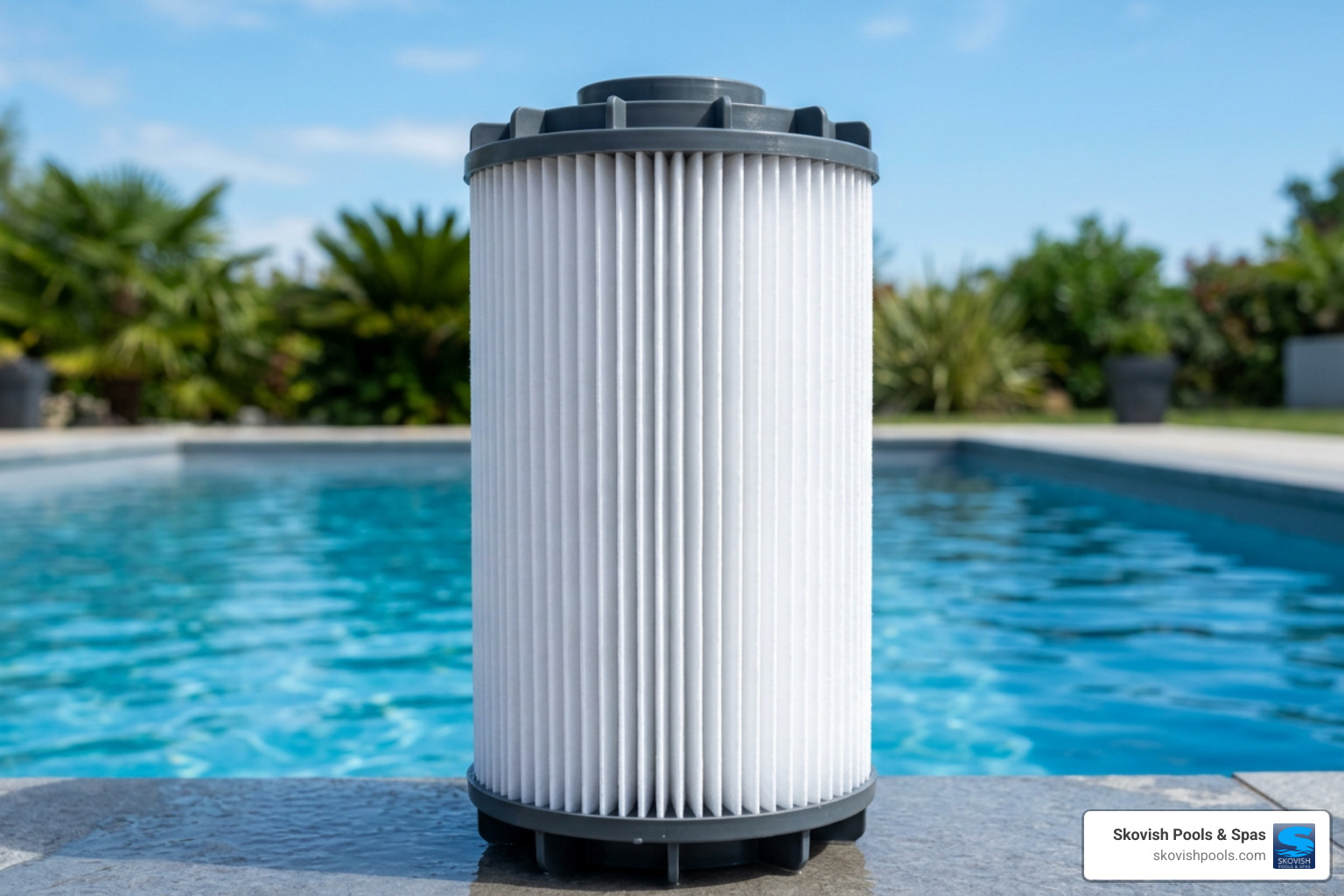
- Continuous Filtration & Recirculation: We run the pool pump continuously for 24 to 48 hours. As the chlorine kills the algae, the water will transition from dark green to a cloudy, milky blue. We monitor the filter pressure and backwash or clean the filter grids daily as they trap the dead algae.
- Vacuuming to Waste: Once the dead algae settles to the pool floor as a gray, powdery mist, we use professional external pumps or set the pool’s multiport valve to “Waste” to vacuum the debris directly out of the pool, preventing it from overloading your home filter system.
This meticulous process is why homeowners trust an affordable pool cleaning company Hazleton PA to handle comprehensive green pool cleanups and targeted green pool treatments.
Preventing Algae Recurrence: Chemistry, Filtration, and Climate
Once your pool is sparkling clear again, the goal is to keep it that way. Preventing algae from returning is a continuous balancing act of chemistry, mechanical filtration, and adapting to our local Pennsylvania weather.
The Role of Water Chemistry and Filtration
The best defense against algae is a strong, consistent sanitation routine. You should never let your free chlorine level drop below 1.5 to 3.0 ppm.
- pH Balance: Keep your pH strictly between 7.2 and 7.6. If your pH climbs too high (above 7.8), your chlorine loses up to 50% of its sanitizing power.
- Daily Circulation: Water must move to stay clean. Run your pool pump for at least 8 to 12 hours daily (or 24 hours during peak summer heatwaves) to prevent stagnant zones.
- Phosphate Management: Phosphates enter your pool via lawn fertilizers, decaying leaves, and rain. They act as gourmet food for algae. Keep phosphate levels below 125 ppb by using commercial phosphate removers available at your local pool supply store near me in PA.
How Pennsylvania Climate Affects Algae Growth
Northeastern Pennsylvania presents unique environmental challenges for pool owners. Our hot, humid summers, paired with sudden, heavy rainstorms, can rapidly alter your pool’s chemistry. Heavy rain dilutes your sanitizer levels, alters pH, and introduces organic contaminants and wild algae spores directly into the water.
Spring pollen from our dense oak and pine trees acts as an organic fuel source for algae, while winterizing your pool incorrectly can lead to a massive swamp when you open it in the spring. Understanding pool opening how to maintain crystal clear sparkling water is essential for starting your season on the right foot.
Furthermore, if you use a heating system, keep in mind that warmer water accelerates algae reproduction. Balancing your heating choices—such as evaluating a swimming pool heat pump vs pool gas heater—can help you manage both comfort and algae-prone water temperatures.
For consistent year-round protection, many homeowners rely on professional pool cleaning maintenance Carbon County PA to adjust chemical dosages dynamically as local weather patterns shift.
Frequently Asked Questions About Algae Removal Pool Service
How long does professional algae removal pool service typically take?
The timeline depends entirely on the severity of the bloom:
- Light Algae Bloom: (Water is slightly hazy, and you can still see the pool floor) – Typically takes 48 hours of continuous filtration, brushing, and shocking to clear.
- Moderate Bloom: (Water is green, but you can see the second step of the ladder) – Usually requires 3 to 5 days of daily brushing, chemical adjustments, and filter cleanings.
- Severe Black/Dark Green Swamp: (You cannot see the bottom of the shallow end) – Can take 7 to 10 days or longer to fully restore, as it often requires multiple rounds of chemical treatments, flocculants, and physical vacuuming to waste.
What are the signs that my pool needs professional algae treatment?
Look out for these early warning signs before a full-blown outbreak occurs:
- Slippery Surfaces: If your pool steps, walls, or ladder feel slick or slimy, microscopic algae colonies are already forming.
- Rapid Chlorine Loss: If you find yourself adding chlorine daily but your test kit consistently reads zero, algae is actively consuming the sanitizer before it can register.
- Cloudy Water: A sudden loss of water clarity or a dull, milky appearance is often the precursor to a green bloom.
- A Green or Mustard Tint: Visible streaks of green, yellow, or dark spots on the plaster or tile grout.
Is it safe to swim in a pool during or after algae treatment?
No, you should never swim in a pool while it is undergoing active algae treatment.
First, algae itself can harbor harmful bacteria like E. coli and pseudomonas, which cause skin rashes, ear infections, and gastrointestinal distress. Second, the extremely high levels of chlorine (often 10 to 20 times normal levels) used during breakpoint chlorination can cause severe skin and eye irritation, respiratory discomfort, and damage to swimwear. For general swimmer health guidance, the CDC’s healthy swimming resources also emphasize the importance of proper pool chemistry and clear, well-maintained water.
It is only safe to return to the water once the algae is completely gone, the water is crystal clear, and your free chlorine levels have naturally drifted back down to a safe range of 1.0 to 4.0 ppm.
Reclaim Your Crystal-Clear Oasis with Skovish Pools & Spas
A green pool is a stressful, exhausting problem that can quickly ruin your summer plans. But you don’t have to fight the battle against stubborn algae alone.
At Skovish Pools & Spas, we bring over 50 years of dedicated Pennsylvania experience to every pool we service. As a family-owned, one-stop shop with locations in Luzerne and Shickshinny, we provide the expert diagnostics, advanced chemical treatments, and professional care needed to transform your pool back into a sparkling, safe, and healthy oasis.
Whether you need a one-time green-to-clean rescue or ongoing weekly maintenance to ensure algae never returns, our team is here to provide lifelong pool care you can count on.
Don’t spend your weekend scrubbing plaster and guessing at chemical levels. Schedule your professional pool service today and let the experts at Skovish Pools & Spas handle the hard work for you!


